
Generations and their labels
Baby Boomers
The baby boomer generation was born between 1946 and 1964 and, as of Jan. 2021, are between 65 and 75 years old. It is estimated there’s 73-million baby boomers in the USA.
Baby boomers social stats are often misunderstood. Yes, baby boomers prefer, and are most comfortable with face-to-face or phone communication. That said, Notre Dame University of Maryland reports that 93% of baby boomers use email daily. Baby boomers are also using social media more and more.
As of the third-quarter, 2020, American baby boomers were even more likely to be on Facebook than the public as a whole. Stats on Statista show 78% of those 56 and over are on Facebook. Plus, 67% watch YouTube, 40% use Pinterest, 32% use Instagram, 31% use LinkedIn, and 26% use Twitter.
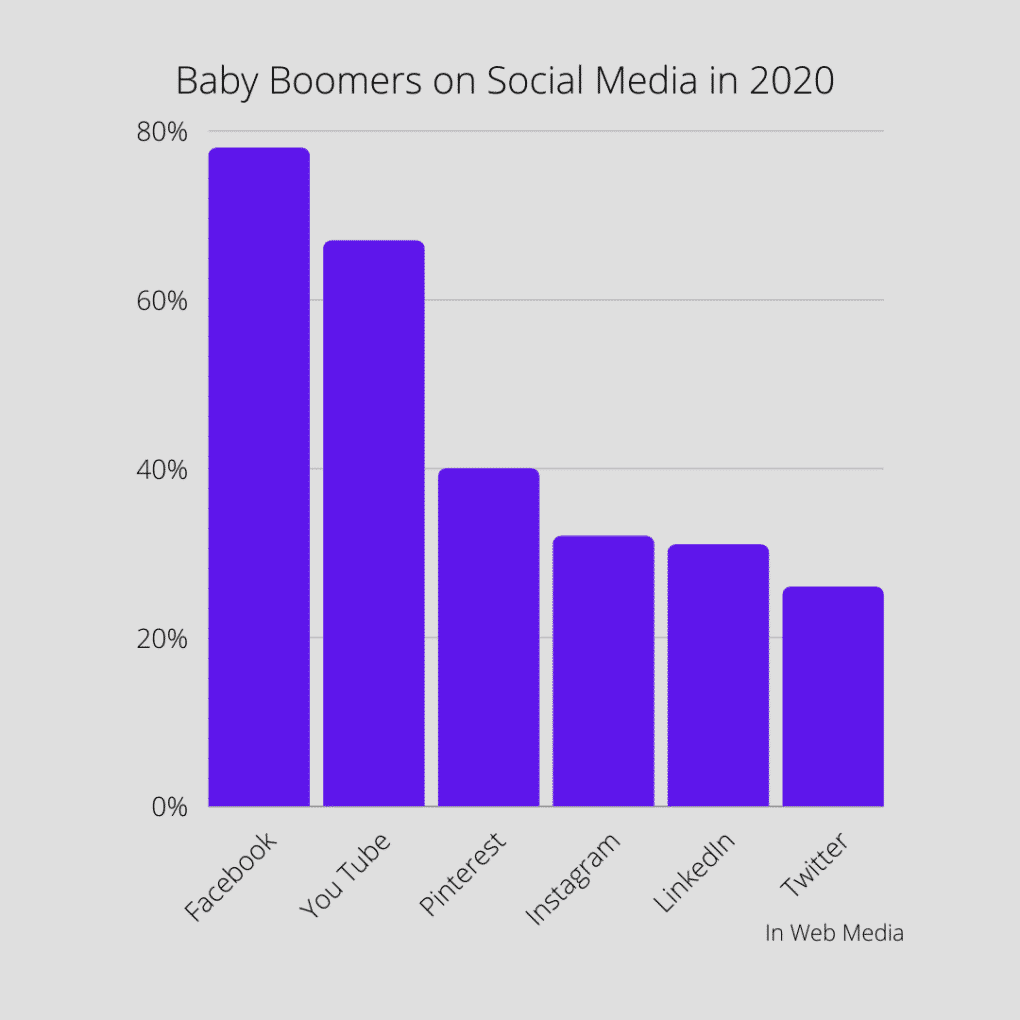
These stats do not mean the average baby boomer is active on all these different social networks. Instead most baby boomers spend their time mainly on just one network. Which one that is differs person-to-person, depending on their individual preference. Thus, a smart marketing strategy for baby boomers, is to target them across multiple social media networks.
Generation X
Those of Generation X were born between 1965 and 1980 and, as of Jan. 2021, will be between 41 and 56 years old. Of which, there are over 65 million in the USA.
Generation X is less likely to adopt a new network as compared to younger generations
On social media, Generation X is less likely to adopt a new network as compared to younger generations. So, their use of networks like Tumblr and TickToc are almost nil. As of 2020, Twitter, Pinterest and Linkedin each report that 40% of Americans 46 to 55 years use their networks. Instagram is only slightly higher with 47%, while YouTube at 70% and Facebook at 76% have the highest numbers.
Generation X is more likely than baby boomers to shop online and will do research on social media and read reviews when making a decision. Instead of phone calls or face-to-face meetings, this generation prefers text messaging to save time. Therefore, a smart marketing approach is to allow for that, by enabling direct messages for questions.
See Why Offering Service Packages is Growing Rapidly
Millennials
Millennials were born between 1981 and 1994 will be between 27 and 40 years old, as of Jan. 2021. There are over 72-million millennials in the USA.
Of all generations, Millennials use the most variety of social media and can be found on every network available. That said, on a daily basis millennials are most active on the largest networks. Daily, in 2020, 77% used Facebook, 70% used Instagram and 66% used YouTube.
On social media Millennials expect companies to make posts that relate to and exemplify their values.
Smart marketing to millennials requires a business to adopt a core set of values. On social media millennials expect companies to make posts that relate to and exemplify their values. They prefer to shop with companies they have values in common with.
Like Generation X, millennials also read reviews and check social media before making a decision, but with a focus that is more about the experience with the company, and slightly less about just the specific product or service.
Since Millennials want to buy where they will have the best overall experience, it is also worthwhile to post case studies and stories about positive experiences.
Generation Z
Like baby boomers, Generation Z, spends most of their time on just a few social media platforms that they prefer. You Tube, Instagram and Snap Chat are the platforms they use most frequently. They also value many of the same things that baby boomers do, yet define those things quite differently.
For example, when a baby boomer says “let’s spend time together” they mean physically, in the same room. Whereas the BBC reports that Generation Z defines being together as either FaceTime or being together. Similarly they define shopping as either online or at a traditional store.
Where Generation Z and baby boomers differ the most is in their straightforwardness. Baby boomers like to think of themselves as straightforward, but often say things they don’t mean. This may be partly because baby boomers grew up in a face-to-face world where, in addition to listening, they could also read body language. Generation Z grew up online, where saying exactly what you mean works best.

In traditional corporate culture there were always unwritten rules. Yet, in an online world, if the rules are unwritten, how is anyone, especially those from Generation Z, supposed to know what those rules are? CEOs are starting to realize this and having to adjust to the reality that, if they tell interns to “keep in touch,” they shouldn’t be be surprised when they start receiving lots of direct messages.
Similarly, marketers sometimes make assumptions about their audience, particularly in the B2B market. However, if striving to develop smart marketing that also speaks to Generation Z, it is important to step-back rethink, distill, then carefully and clearly articulate your messaging, without making any assumptions.